1. Treatment Challenges in Fine Chemical Wastewater
Fine chemical production can generate highly variable wastewater containing solvents, intermediates, dissolved organics, salts, acids, alkalis and other process chemicals. Wastewater characteristics depend strongly on the products and manufacturing routes.
Batch-to-Batch Variations: Wastewater composition and concentration may change significantly between production campaigns.
Refractory or Inhibitory Compounds: Some streams require segregation and specialized pretreatment before biological treatment.
Corrosion & Material Compatibility: Equipment materials must be assessed against chemical exposure and operating conditions.
Complex Sludge Properties: Physicochemical sludge may require dedicated conditioning and dewatering evaluation.
2. Treatment Process & Equipment Solutions
Equipment Selection for Process-Specific Chemical Wastewater Treatment
Fine chemical wastewater treatment often requires stream segregation, equalization, specialized pretreatment and, where suitable, biological treatment. No single standard process is appropriate for all fine chemical production facilities.
ODMS Equipment Across the Process
Transfer & Applicable Screening: Submersible pumps and rotary drum microscreen filters, subject to chemical compatibility.
Physicochemical Treatment: Chemical dosing systems, DAF systems and sludge scrapers where applicable.
Biological Treatment & Aeration: Magnetic levitation turbo blowers, disc diffusers, tube diffusers, TPU aeration hoses, submersible mixers and flow propellers where treatment conditions permit.
Sludge Dewatering: Multi-disc screw presses, decanter centrifuges and polymer preparation and dosing systems, subject to sludge characteristics.
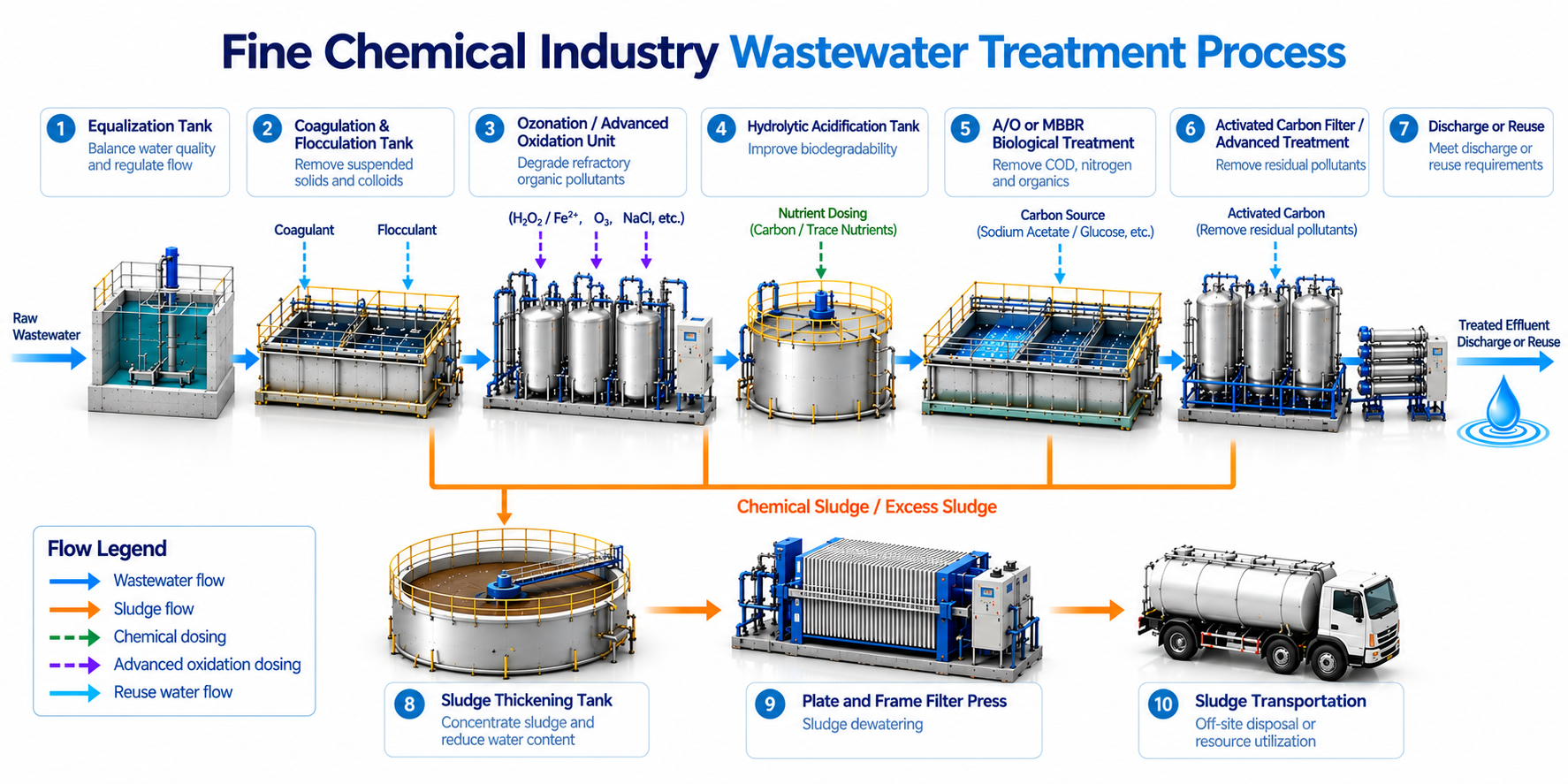
Reference Process Flow
Wastewater Segregation → Equalization / pH Adjustment → Specialized Pretreatment → Physicochemical Separation (If Required) → Biological Treatment & Aeration (If Suitable) → Advanced Treatment → Discharge / Reuse
Separate Sludge Line: Process Sludge → Characterization → Suitable Conditioning & Dewatering
3. Engineered Around Wastewater Chemistry
Wastewater Characterization: Review chemical composition, COD, BOD, TDS, pH, temperature and potential inhibitory compounds.
Material & Equipment Suitability: Assess chemical compatibility, equipment operating limits and required construction materials.
Aeration System Engineering: Evaluate biological treatment suitability before matching blower capacity, diffuser materials and oxygen demand.
Sludge & Interface Coordination: Review sludge characteristics, treatment capacity, piping, controls and maintenance requirements.
4. Reliability Is Engineered — Not Assumed.
Reliable Configuration: Confirm chemical compatibility and equipment operating conditions before finalizing the configuration.
Precision Engineering: Review equipment interfaces, materials and control requirements against project specifications.
Rigorous Delivery Verification: Conduct applicable inspections and functional checks in accordance with agreed requirements.
5. Get Equipment Recommendations for Your Fine Chemical Wastewater Project
Share your wastewater composition, flow rate, pH, temperature, treatment objectives, process flow diagram and equipment specifications. ODMS can assess equipment suitability and support technical selection.
CTA: Request Technical Review & Quote