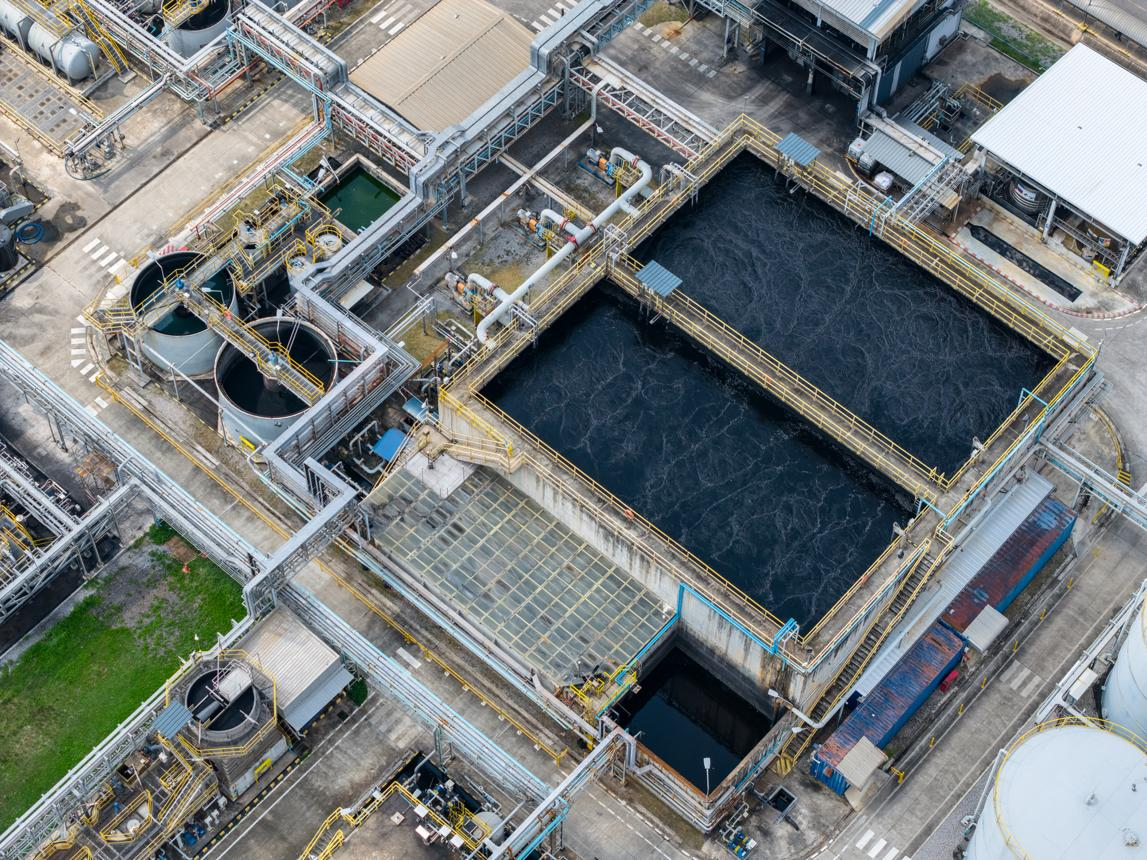
1. Petrochemical Wastewater Treatment Project, Thailand
Project Location: Thailand
Design Treatment Capacity: 50,000 m³/d
Wastewater Type: Petrochemical Industrial Wastewater
Key Equipment: Chemical Dosing System, Dissolved Air Flotation System, Aeration System, Sludge Scraper and Multi-Disc Screw Press
Petrochemical production can generate wastewater streams with varying concentrations of oil, suspended solids and organic pollutants, depending on the production processes, cooling systems and wastewater collection arrangements. A treatment system of this scale requires coordinated pretreatment, solids separation, biological treatment and sludge management.
For this reference project, the proposed ODMS equipment package covers five key equipment categories: chemical dosing, dissolved air flotation, biological aeration, sludge collection and mechanical dewatering.
The chemical dosing system and dissolved air flotation unit can support pretreatment and the removal of suitable oil droplets and suspended solids. The aeration system supports biological treatment where wastewater characteristics permit, while the sludge scraper and multi-disc screw press support subsequent sludge collection and dewatering.
The final treatment process and equipment capacities must be confirmed through wastewater characterization, hydraulic calculations and process design.
2. Five Key Challenges in Petrochemical Wastewater Treatment
01 | Oil and Suspended Solids Removal
Wastewater containing free oil, dispersed oil or suspended solids may require suitable separation before downstream biological treatment. The appropriate separation method depends on oil characteristics, particle properties and influent conditions.
02 | Variable Organic Loading
Different production units may discharge wastewater with varying COD concentrations and biodegradability. Equalization and appropriate pretreatment may be necessary to protect downstream treatment processes.
03 | Chemical Treatment Control
Coagulant and flocculant selection, dosage and mixing conditions affect flotation performance. Chemical dosing must be based on wastewater testing and process requirements rather than a fixed dosage assumption.
04 | Biological Treatment Compatibility
Not all petrochemical wastewater is suitable for direct biological treatment. Oil content, toxicity, salinity and poorly biodegradable compounds must be assessed before determining aeration requirements and biological process configuration.
05 | Sludge Collection and Disposal
Flotation and clarification processes may generate sludge containing concentrated solids, oil or chemical residues. Collection, conditioning and dewatering arrangements must match the sludge characteristics and applicable disposal requirements.
3. Five Equipment Categories Supporting Key Treatment Stages
01 | Chemical Dosing System
Provides controlled dosing of coagulants, flocculants, pH adjustment chemicals or other treatment agents where required. Chemical selection and dosage should be established through wastewater testing and process evaluation.
02 | Dissolved Air Flotation System
Uses pressurized dissolved air to generate fine bubbles that attach to suitable suspended particles and oil droplets, allowing them to rise to the surface for removal. DAF performance depends on wastewater characteristics, chemical conditioning and hydraulic loading.
03 | Aeration System
Combines blowers and aeration diffusers to supply and distribute process air in biological treatment tanks. Airflow, operating pressure and diffuser arrangement must be matched to the biodegradable load and oxygen demand. Biological treatment should only be applied after confirming wastewater treatability.
04 | Sludge Scraper
Collects settled sludge from the bottom of clarifiers or sedimentation tanks and directs it toward the designated sludge withdrawal point. The scraper configuration depends on tank geometry and the selected clarification process.
05 | Multi-Disc Screw Press
Mechanically dewaters suitable sludge generated by pretreatment, flotation or biological treatment. Performance depends on sludge composition, feed solids concentration, conditioning requirements and operating settings.
Process Integration
The five equipment categories are selected to support different treatment functions. Their final sequence, capacity and interfaces must be established from the actual process flow diagram and engineering calculations; they should not be assumed to form a universal treatment train for every petrochemical wastewater stream.
4. An Equipment Package Designed Around Petrochemical Wastewater Requirements
01 | Support for Pretreatment and Solids Separation
Chemical dosing and dissolved air flotation can work together where testing confirms that chemical conditioning and flotation are appropriate for the wastewater. This supports the removal of suitable oil droplets and suspended solids before subsequent treatment.
02 | A Defined Aeration Solution for Biodegradable Loads
The aeration system supports biological treatment where the wastewater is sufficiently biodegradable and compatible with the selected process. Correct blower and diffuser selection helps meet oxygen demand under the intended operating conditions.
03 | Sludge Collection and Dewatering
The sludge scraper and multi-disc screw press address different stages of sludge management, from collection to mechanical dewatering, helping prepare suitable sludge for further handling.
04 | Coordination Across Multiple Equipment Categories
ODMS can coordinate equipment selection across chemical dosing, flotation, aeration, sludge collection and dewatering. This can help consolidate technical communication and procurement coordination, subject to a clearly defined supply scope.
05 | Configuration Based on Actual Wastewater Characteristics
Rather than applying one standard configuration to every petrochemical plant, equipment selection should consider flow rate, oil content, COD, biodegradability, salinity, toxicity and sludge characteristics.
Actual pollutant removal, energy consumption, sludge reduction and operating cost improvements must be demonstrated using verified project data.
5. Why ODMS for Petrochemical Wastewater Projects?
Equipment Selection Based on Process Requirements
01 | Multi-Stage Equipment Coverage
ODMS offers equipment for chemical dosing, dissolved air flotation, biological aeration, sludge collection and mechanical dewatering, supporting several key functions within an industrial wastewater treatment system.
02 | Application-Based Configuration
Equipment selection should reflect the actual wastewater characteristics and process requirements, including oil separation, chemical conditioning, biological treatability and sludge handling.
03 | Coordinated Aeration Equipment
Blowers and diffusers must be evaluated as a system, with airflow, operating pressure and oxygen demand considered together.
04 | Sludge Handling Options
Sludge scrapers and multi-disc screw presses support collection and dewatering where appropriate. Final selection depends on tank design, sludge characteristics and required capacity.
05 | Technical Review for Project Teams
ODMS can review available process diagrams, wastewater analysis and equipment specifications to help identify suitable equipment configurations for a project.
6. Planning a Petrochemical Wastewater Treatment Project in Thailand?
Petrochemical wastewater varies significantly between production facilities. The right equipment configuration depends on wastewater flow, oil content, organic loading, biodegradability and sludge characteristics.
Share your project information to discuss suitable equipment options:
- Design wastewater flow and operating schedule
- Influent COD, oil and grease, suspended solids and other available water quality data;
- Existing pretreatment and biological treatment processes;
- Required effluent discharge or reuse targets;
- Sludge production and dewatering requirements;
- Existing equipment specifications, if this is an upgrade project.
Secondary CTA: Discuss Your Project with ODMS
ODMS can review your technical requirements and help identify suitable equipment configurations based on the intended treatment process.